
GREATGADETS / SMALL BUSINESS STARTUP GUIDE
How to Start a Car Washing Business Without Overspending
The equipment worth buying first, what can wait, and how to build a realistic car washing setup on a $500, $1,000, or $2,000 equipment budget.
2026 buying guide • Beginner-friendly • Equipment, pricing, and business basics
Affiliate disclosure: As an Amazon Associate I earn from qualifying purchases. Some links may earn GreatGadets a commission at no extra cost to you. Product recommendations below are based on documented features and published information, not first hand testing by GreatGadets.
It is easy to make starting a car washing business look expensive. Scroll through detailing videos and you will see pressure washers, wall mounted hose reels, extractors, polishers, generators, and customized vans. Some of that equipment has a place. Very little of it needs to be your first purchase.
For a new operator, the more useful question is what service can I consistently deliver with the tools I already have access to? A careful maintenance wash and a straightforward interior refresh can be a sensible first offering. They require attention to detail, clean supplies, and a repeatable process more than an impressive-looking garage.
This article focuses on the U.S. market, using researched equipment examples and three illustrative budgets. These budgets are for supplies and equipment, not an all in estimate for a licensed, insured business. Transportation, water access, safe wastewater handling, and local permits can change the economics substantially.
IN THIS GUIDE
Choose your service · Build a starter kit · $500–$2,000 budgets · Run your first jobs · Set prices
START WITH THE BUSINESS MODEL
Before shopping, decide what kind of car wash you want to run
There is a big difference between a basic maintenance wash, a mobile interior clean, and a full paint correction detail. They may all show up in online searches for “car detailing,” but their equipment, time, risk, and skill requirements are not the same.
A good entry point is a maintenance focused service for reasonably well kept cars: exterior wash, wheels, glass, and a light interior vacuum and wipe down. This is easier to standardize than promising stain extraction, odor removal, engine bay cleaning, or scratch correction on every vehicle. You can add those services after practicing and confirming there is demand.
You also need to decide whether customers come to a permitted location or you go to them. Mobile washing sounds convenient, but it raises practical questions: Where will water and electricity come from? Can you legally wash at that address? Where will the wastewater go? A low water method reduces what you have to carry, but does not eliminate the need to handle wastewater correctly.
THE STARTER KIT
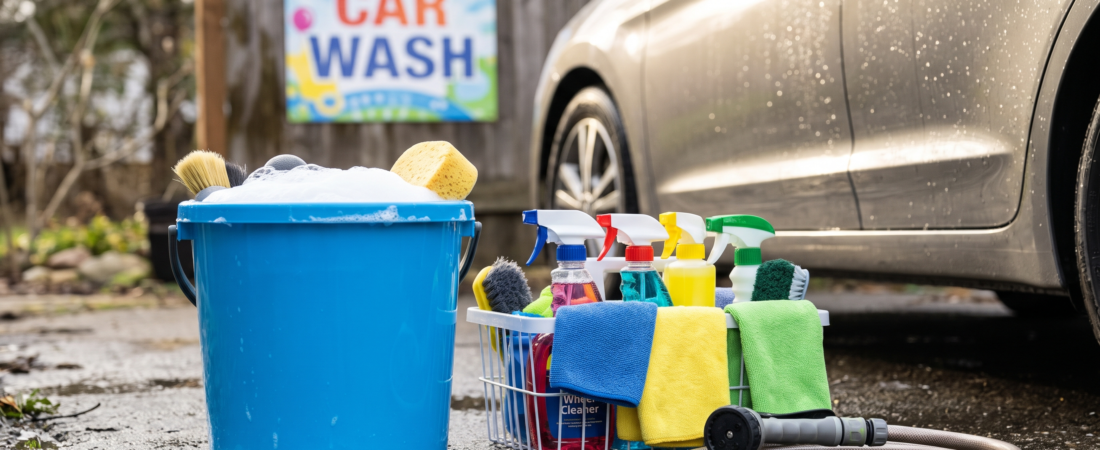
Build your first wash around towels, not machines
For lightly dirty maintenance washes, a rinseless wash can simplify setup. Instead of covering the vehicle in foam and rinsing with a hose, you clean a section using appropriately diluted solution and clean wash media, then dry that section with a fresh towel. The method uses little water and avoids buying a pressure washer immediately. It is not a shortcut for washing a car covered in abrasive mud, sand, or heavy road salt: those conditions call for appropriate pre-rinsing or a different service.

THE FIRST CHEMICAL TO CONSIDER
Optimum No Rinse Wash & Shine V6 (32 oz)
Optimum No Rinse is a concentrated rinseless product suited to routine, lightly soiled vehicles. It makes a good starting point when a traditional hose and rinse setup would add cost or logistical complexity.
Before buying: Follow the latest bottle dilution directions and use clean wash media. Heavy grit should be removed before contact washing.
Find on Amazon →A safe, tidy process matters more than a fancy bottle. Use two basic wash buckets with grit guards, or an appropriate clean media rinseless technique. The two bucket and grit guard setup is a low cost organizational aid; the Cyclone Ultra wash mitt is an example of dedicated wash media. Keep wheel tools separate from paint towels so gritty brake dust does not get dragged across the bodywork.
If you want consistent results, spend money on microfiber before you spend it on accessories. You need enough clean towels to avoid reusing dirty sections across multiple vehicles, plus a distinct drying towel.

BUY EXTRA OF THESE
The Rag Company Edgeless 300 (10-Pack)
A pack of reliable microfiber towels is useful for wiping appropriate surfaces, drying smaller areas, and maintaining clean working stock between customers.
Before buying: Separate towels by task and launder them according to their care instructions. Do not use gritty or contaminated towels on paint.
Find on Amazon →A dedicated absorbent drying towel, such as the Gauntlet from The Rag Company, can help reduce repeated passes over wet panels. You do not need dozens at the beginning, but having clean replacements ready is more valuable than a large collection of specialty products.
WHERE YOUR VALUE CAN GROW
Add one simple interior service that customers understand
A wash only business competes heavily on convenience and price. A basic interior refresh gives you a way to make each appointment more valuable without immediately moving into advanced detailing. Vacuum the seats, mats, and accessible carpet; dust crevices; wipe compatible hard surfaces; and clean the interior glass.
A wet/dry vacuum is one of the few pieces of equipment I would strongly consider early if you plan to offer interior work. Choose a tool you can safely power, transport, and clean after use.

PRACTICAL INTERIOR STARTER
Stanley – SL18116P Wet/Dry Vacuum, 6 Gallon, 4 Horsepower
The Stanley 6-gallon wet/dry vacuum is a low cost example of a capable corded shop vacuum. It can handle everyday debris in footwells, mats, and upholstery when used with suitable attachments.
Before buying: It requires appropriate electrical power.
Find on Amazon →For wipe downs, use a product labeled for the exact surface. P&S Xpress Interior Cleaner is one option for compatible interior surfaces; Stoner Invisible Glass is a dedicated glass cleaner. A set of Detail Factory ultra-soft brushes helps work dust out of vent louvers and seams, provided you use light pressure and avoid delicate screens or sensitive finishes.

USE THE RIGHT CLEANER
P&S Xpress Interior Cleaner (16 oz)
A dedicated interior cleaner can simplify the routine for common hard surfaces. It is more useful initially than buying a different specialty bottle for every interior panel.
Before buying: Test an inconspicuous area first and follow the label. Never assume a cleaner is safe for every display, leather finish, or coated surface.
Find on Amazon →A basic interior refresh is not the same as deep stain removal. Do not promise to remove long set pet odors, dye transfer, or every upholstery stain until you have the training, equipment, and realistic expectations to deliver that service.
THE NEXT UPGRADE
When should you buy a pressure washer?
Once you have appointments that require traditional washing, a compact electric pressure washer can save effort during rinsing and pre-washing. It is not mandatory for every maintenance service, and excessive pressure or poor technique can damage vulnerable trim, seals, finishes, and other parts. Use vehicle appropriate pressure, distance, and nozzles, and follow the equipment directions.

UPGRADE WHEN BOOKINGS JUSTIFY IT
Westinghouse ePX3500 Electric Pressure Washer
The Westinghouse ePX3500 Electric Pressure Washer is a more modest upgrade than a large commercial machine. It is appropriate to consider when you have reliable, permitted access to water and power.
Before buying: Confirm local electrical requirements, hose and fitting compatibility, water supply, and safe pressure washing practices.
Find on Amazon →A conventional wash needs suitable shampoo and a dependable hose. P&S Pearl Auto Shampoo is one example of a dedicated automotive shampoo, and the Flexzilla 50-foot garden hose can extend your working area when compatible with the hookup. For wheels, use an appropriate wheel and tire product such as P&S Brake Buster; follow the product label and check the wheel finish before use.
A foam cannon such as the MTM Hydro PF22.2 can help with the experience and pre-wash workflow, but it is an optional investment. A well executed contact wash does not require mountains of foam, and a foam cannon will not replace proper pre-rinsing, clean wash media, and safe drying.
THREE REALISTIC PATHS
What a $500, $1,000, or $2,000 setup actually looks like
The right budget depends on the service you sell. These are equipment-and-consumables planning ranges, not guaranteed shopping cart totals. They assume you already own a suitable vehicle and have legally permitted access to water, electricity, and a compliant wash location or wastewater solution. Tax, shipping, insurance, business filings, and travel are additional.
BEGINNER / KEEP IT LEAN
Around $500: prove the service first
An illustrative $300–$450 equipment kit can include rinseless solution, buckets, wash media, microfiber and drying towels, a basic vacuum, interior and glass cleaners, brushes, spray bottles, protective gear, and a modest supply buffer. Use the remaining budget for replacements and unexpected needs. Skip the pressure washer, foam cannon, extractor, and polisher until you know exactly why you need them.
At this stage, your priority is learning to complete a repeatable job without wasting supplies or underestimating how long the work takes. Practice on your own vehicle, then time a second practice run. If the service takes three hours when you expected one, that is information you need before setting your customer prices.
GROWING / BETTER WORKFLOW
Around $1,000: improve speed and capacity
An illustrative $650–$900 equipment spend can build on the basic kit with an electric pressure washer, a quality hose, additional towels and wash media, larger chemical quantities, better attachments, and organized storage. Reserve cash for supplies and repairs instead of spending the entire amount on a single machine.
This is the point where buying in larger quantities may start to make sense. Larger shampoo bottles and properly maintained towels can lower per-job consumable costs, but only if you actually use them. Avoid buying chemicals for services you do not yet offer.
EXPANSION / SPECIALIZED SERVICES
Around $2,000: add one profitable specialty
An illustrative $1,200–$1,800 equipment setup can add a portable upholstery spot cleaner, more towels and brushes, spare hoses, lighting, and additional storage. Consider a specialty upgrade only when you have the skills and demand. This is still not a completely self contained, wastewater compliant mobile van setup.
If you plan to work completely independently of customer utilities, the cost picture changes quickly. Water tanks need safe mounting and transport; pumps and power systems must be matched to equipment demand; and wastewater collection and permitted disposal can add significant expense. Do not treat the equipment budgets above as proof that you can operate legally anywhere for those dollar amounts.
SPEND WHEN IT PAYS
Two upgrades I would delay until customers ask for them
You can make a basic wash look excellent without promising deep upholstery extraction or machine polishing. Those are different services, and each introduces more time, training, and liability. The sensible upgrade is the one that addresses a problem customers are willing to pay to solve.

ONLY AFTER PRACTICE
BISSELL Little Green Portable Cleaner (1400B)
A portable spot cleaner like the BISSELL Little Green can help with certain fabric and carpet jobs after you have learned surface compatibility, moisture control, and drying procedures.
Before buying: Not every stain can be removed, and excessive moisture can cause problems. Practice on suitable materials and avoid making universal stain-removal guarantees.
Find on Amazon →A simple protective finishing service can also be worth exploring. A compatible spray protectant such as Turtle Wax Hybrid Solutions Ceramic Spray Coating may suit a defined add on service when applied according to its instructions. The key is promising only the protection and longevity supported by the product and by your actual technique.

ADVANCED — NOT A DAY-ONE PURCHASE
AOBEN Car Buffer Polisher
The A0BEN Car Buffer Polisher is a random orbital machine used for polishing work. It belongs in a later phase if you decide to offer paint enhancement or correction not in the first car-washing kit.
Before buying: Get proper training, practice paint measurement and technique, and verify insurance coverage before taking paid correction jobs.
Find on Amazon →BEFORE THE FIRST CUSTOMER
The business expenses that do not appear in your shopping cart
Buying towels is the easy part. Before accepting money, check business registration and any local licensing requirements, insurance that covers the work you will perform on customers’ vehicles, property owner permission, safe access to water and electricity, and how you will manage wastewater. The U.S. Small Business Administration specifically recommends budgeting for permits, insurance, marketing, and recurring operating costs not only equipment.
Commercial washwater can contain detergent, oils, metals, road dirt, and other contaminants. Water that flows down a driveway may reach a storm drain, not a treatment plant. A rinseless process can reduce water volume but does not automatically authorize disposal. Ask the relevant city stormwater or wastewater authority what collection and disposal methods are permitted for a mobile or fixed site commercial service.
Do not skip local wastewater rules
“Biodegradable” on a bottle does not automatically make commercial discharge into a storm drain legal. Check local rules and plan an approved way to prevent runoff and manage waste before promising mobile exterior washes.
Other ongoing costs include fuel, mileage, chemicals, microfiber laundry, vacuum bags or filters, broken tools, booking software, and time spent driving between jobs. A business can look profitable on paper when you only count the soap, then become disappointing once you count the actual hours invested.
PRICING THAT INCLUDES YOUR TIME
How to price a first job without guessing
Start with the amount of time the service actually takes. Include travel, setup, washing, cleanup, customer communication, supplies, and a share of overhead. An easy planning formula is labor hours × target hourly pay + consumables + travel + overhead and margin buffer = estimated quote.
ILLUSTRATIVE EXAMPLE — NOT A MARKET RATE
2 hours × $25 target labor = $50
Consumables = $8
Travel allocation = $10
Overhead / margin buffer = $12
Illustrative quote: $80
That $80 example is not a recommendation for what to charge in your area, nor does it guarantee profit. Use your actual costs, local competition, vehicle condition, and service quality to set prices. A minivan with three rows of pet hair is not the same job as a lightly used compact sedan, and a clearly defined service menu prevents misunderstandings.
When you start seeing regular bookings, track your effective hourly return after direct expenses. If an add on takes 40 extra minutes but earns very little, it may be better to simplify the menu than to buy more equipment.
A SIMPLE LAUNCH PLAN
How I would handle the first few customers
First, test your workflow on your own car or a volunteer’s vehicle with permission. Take consistent before and after photographs, log how much product you used, note what went wrong, and refine your process. Do not promise a premium detail until you can consistently deliver the basic service.
Next, put together a simple service page: what the wash includes, what it excludes, how much time to expect, what access you need at the customer’s property, and how booking and payment work. Clear boundaries are especially important for stains, paint defects, and heavily contaminated vehicles.
Finally, use early jobs to learn where demand is strongest. If customers keep asking for interiors, an extractor might make sense later. If exterior washes dominate, improve your wash and dry routine and equipment organization instead. Let actual work direct the next purchase.
FAQ
Common questions before buying equipment
Can I really start with only $500?
Possibly for a narrow, basic service if you already have transportation, an approved wash location or permitted utility access, and other business necessities. The $500 figure here is an equipment budget, not a full legal startup budget.
Do I need a pressure washer?
No, not for every lightly soiled maintenance wash. Heavily contaminated vehicles may require appropriate pre-rinsing or a different washing approach. A pressure washer becomes useful as your service mix expands.
What is the first tool worth upgrading?
For interior-heavy work, better vacuum tools and clean microfiber stock often help more than cosmetic accessories. For traditional exterior washing, hose organization and a suitable electric pressure washer may improve workflow.
Should I offer paint correction right away?
Not without training, practice, suitable equipment, and appropriate insurance. Polishing can affect clear coat and carries different risks than routine washing.
Where can I get the products?
The links throughout this article go to product searches or retailer pages, not verified live Amazon product listings. Confirm the exact model and current price before ordering; replace eligible URLs with your approved affiliate links when publishing.
FINAL TAKEAWAY
The bottom line: buy for the work you can deliver
If I were setting up a budget conscious car washing operation, I would begin with a safe wash method, quality towels, a basic vacuum, and the few cleaners needed for a clearly defined service. I would learn the true cost and time of each job before buying bigger machines. Good technique, consistency, and business compliance come before a polished equipment wall.
The smartest equipment budget is not the one that buys the most gadgets. It is the one that leaves you with enough money, time, and flexibility to do the next job well.
Sources and editorial notes
This guide was developed using manufacturer instructions, retailer product information, and official U.S. small business and wastewater resources. Product features and reference prices may change. GreatGadets has not personally tested all the listed equipment.
Optimum ONR product directions · SBA: plan business startup costs · SBA: permits and insurance · EPA vehicle washwater guidance